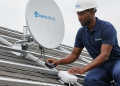
Starlink, the low-Earth-orbit satellite internet service run by Elon Musk’s SpaceX, ended June 2026 with 27,616 subscribers in Kenya, an increase of 10,191 users over the year, according to the latest quarterly sector statistics from the Communications Authority of Kenya, the country’s telecoms regulator. Space in Africa reported the figures on 23 September 2026, putting Starlink seventh among Kenyan internet service providers and at 1% of the ISP market.
Key facts
- Subscribers: 27,616 in June 2026, up 58.48% from June 2025, Space in Africa reports.
- Quarter-on-quarter: up from 24,999, a rise of 10.47%, or 2,617 net additions.
- Market share: 1%, described by Space in Africa as Starlink’s highest level since launch in Kenya.
- Ranking: seventh among Kenyan ISPs, according to the Communications Authority’s report.
- Orders: new residential sign-ups are again suspended in seven high-demand counties, including Nairobi, Kiambu and Mombasa, with waiting lists in place.
- Wider market: satellite subscriptions rose 54.4% year-on-year to nearly 27,700, of which Starlink Internet Services Kenya accounted for 27,616, TechTrendsKE reports.
Why it matters
Space in Africa says the numbers suggest Starlink’s growth in Kenya is becoming more resilient despite recurring network capacity constraints. In earlier periods, the outlet notes, subscription pauses were followed by slower or even negative net additions; this time the company kept expanding while managing demand in congested service areas.
On that reading, capacity limits are no longer halting net growth outright, which Space in Africa describes as a more balanced relationship between new customer additions and Starlink’s ongoing network expansion. For buyers comparing options, Starlink Kenya plans and how they compare with Safaricom remain the practical question behind the regulator’s totals.
The capacity pause
Both outlets report the same constraint. Space in Africa says Starlink has once again suspended new residential orders in seven high-demand counties, with prospective customers moved onto waiting lists until more capacity becomes available. TechTrendsKE frames the episode as evidence that satellite can bypass some physical limits of terrestrial last-mile deployment while its network still has finite capacity in particular service areas.
How rivals are growing
Starlink was not the fastest-growing ISP in the quarter. Space in Africa reports that Vilcom Network Limited recorded quarterly subscriber growth of 16.48% against Starlink’s 10.47%, and held a much larger 6.6% market share. Starlink’s market-share growth was slightly faster, at 11% compared with Vilcom’s 10%.
Kenya’s biggest providers added far more users in absolute terms. Safaricom, the country’s largest mobile and fixed operator, crossed one million subscribers and lifted its share to 36%, Space in Africa reports, coinciding with an April upgrade of its Home Fibre packages that raised speeds without increasing monthly prices and lowered the effective cost per Mbps. The outlet stresses the available data does not establish a causal link.
Jamii Telecommunications Ltd and Wananchi Group (Kenya) Ltd, the second- and third-largest ISPs by subscriber base, added 23,733 and 17,768 users respectively over the same period, against Starlink’s 2,617.
A fibre-led market
TechTrendsKE reports that Kenya’s fixed internet market reached 2.84 million connections in the year to June 2026, with fixed data and internet subscriptions up 32.4%. Fibre optic connections rose 29.7% to 1.57 million, more than half of all fixed connections. A category covering other fixed technologies, including radio-based deployments from operators such as Airtel, Jamii Telecommunications and Fiberlink, grew 471.1% from a much smaller base.
Against that, TechTrendsKE says Starlink’s roughly 1% share is small, but that “satellite has a different infrastructure proposition,” because it can deliver broadband without a terrestrial last-mile network reaching the premises.
Kenya in the African picture
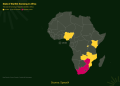
Starlink is now available in 30 African markets, Space in Africa reports, with adoption varying widely. Nigeria’s 98,642 subscribers are almost four times Kenya’s base, and Zimbabwe, where Starlink sells residential service from about $80 a month under a POTRAZ licence, has 86,488, just over three times Kenya’s total. Ghana also exceeds Kenya on subscriber numbers.
Space in Africa attributes those differences to population size, connectivity needs, competitive ISP markets and regulatory environments, rather than to any single factor. Readers tracking where the service is cleared to operate can follow the country-by-country licensing picture.
What the sources do and do not say
The two reports differ in framing rather than substance. Space in Africa gives Starlink’s own year-on-year growth as 58.48%; TechTrendsKE reports 54.4% growth for Kenya’s whole satellite internet category, which reached nearly 27,700 subscriptions. Neither source states when Starlink will reopen residential orders in the seven affected counties, and neither gives current Kenyan pricing.
Frequently Asked Questions
What happens if you try to order Starlink residential service in Nairobi or Mombasa now?
Space in Africa reports that Starlink has again suspended new residential orders in seven high-demand Kenyan counties, among them Nairobi, Kiambu and Mombasa. Prospective customers in those counties are placed on waiting lists until additional network capacity becomes available. TechTrendsKE describes the same episode as a temporary stop on new residential customers in several high-demand counties during 2026.
Why did Kenya’s satellite bandwidth capacity fall while satellite subscriptions rose?
The Communications Authority of Kenya attributes the decline mainly to migration from VSAT to LEO technology, according to Space in Africa. Total available satellite bandwidth capacity fell 19.1% year-on-year, from 0.445 Gbps in June 2025 to 0.360 Gbps in June 2026. Space in Africa adds that utilised bandwidth capacity rose 23.9% while utilised satellite bandwidth fell 18.2%.
What speeds do most fixed internet subscribers in Kenya actually buy?
TechTrendsKE reports that the largest groups of fixed subscriptions sit in the 2–10 Mbps and 10–30 Mbps tiers. Only 1,853 subscriptions nationwide were recorded above 1 Gbps. The outlet also notes that DSL, the copper-based technology, had fallen to just 23 subscriptions by June.
How much international bandwidth does Kenya now have?
Kenya’s total available international bandwidth reached 28,950 Gbps, an 18.5% increase over the year, TechTrendsKE reports, supplied through submarine cables and satellite links. The outlet lists SEACOM, TEAMS, EASSy, Lion2, DARE1, PEACE and 2Africa among the cable systems carrying that traffic.
Follow Starlink News on Google. Make us a preferred source to see more of our reporting in Google search results.