A thought-leader column published by South African newspaper the Mail & Guardian on 23 September 2026 argues that the public fight over Starlink, SpaceX’s low Earth orbit satellite internet network, is obscuring the real reasons Southern Africa remains poorly connected. The piece takes its headline, “Starlink, a wolf in sheep’s clothing”, from remarks by Dr Rekgotsofetse Chikane, director of the Tayarisha Centre for Digital Governance at the Wits School of Governance.
This report summarises the column, flags which of its figures we could check against primary sources and which we could not, and adds the Starlink price and availability context the column itself never supplies.
Key facts
- Published by the Mail & Guardian on 23 September 2026 as opinion and analysis, not a regulatory announcement.
- It draws on Tayarisha Centre working-paper research and on a study by public policy analyst Dr Leon Tinashe Gwaka, Visions and Voids: A Descriptive Examination of Digital Policy Contradictions and Digital Inclusion Gaps in the Global South.
- Gwaka’s study is cited as saying an estimated 2.6 billion people globally remain offline, most of them in Africa — consistent with the International Telecommunication Union’s Facts and Figures estimate for 2023.
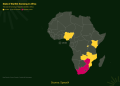
- The column says Nigeria, Kenya, Mozambique and Rwanda moved rapidly to license SpaceX’s constellation, while other regulators stalled.
- It reports that Nigeria’s Universal Service Provision Fund carried forward more than 21 billion naira in unspent balances. No audit year, no source document, and Starlink News has not confirmed it.
- The column quotes no tariffs, speeds or subscriber numbers for Starlink in any market.
Why it matters
For readers weighing satellite internet against local operators, the column reframes the licensing question. According to the Mail & Guardian, whether Starlink is approved in a given market is only one variable; handset taxes, data levies and unspent rural subsidy funds are the larger obstacles keeping people offline. That argument cuts both ways: it denies the satellite lobby its role as liberator, and denies incumbent operators the excuse that coverage economics alone explain the gap.
What the Wits researcher said
Chikane’s framing, as quoted by the newspaper, is that the network makes no secret of its commercial motive: “Starlink is a wolf in sheep’s clothing that doesn’t even bother to wear sheep’s clothing.” The column reports him as saying the operator arrives openly as a profit-seeking business that happens to provide a beneficial service, and that the question worth asking is what happens once it is inside the domestic market.
The paper sets that against continental pledges of universal connectivity by 2030 under the African Union’s Agenda 2063 and the United Nations Global Digital Compact, which it says remain unfulfilled.
The tax contradiction
Gwaka, as summarised by the paper, rejects the idea that exclusion is simply incompetence or lack of money. The column says African states run on conflicting institutional logics: ministries publish digital equity roadmaps while treasuries treat telecoms and consumer electronics as revenue engines. Where the column leaves a date open, we have filled it in from the underlying legislation and marked it accordingly.
| Market | Measure as described | Status |
|---|---|---|
| South Africa | 9% ad valorem luxury excise on imported handsets | Long-standing; relief for devices under R2,500 only as recently as 2025 |
| Rwanda | VAT on mobile devices scrapped, then an 18% levy reinstated | Column says reinstatement followed retail cartels refusing to pass savings on |
| Uganda | Social media (OTT) levy introduced 1 July 2018 | Column says it drove 30% of low-income users offline; abolished 1 July 2021 and replaced by a 12% excise duty on internet data (date added by Starlink News) |
| Tanzania | Taxes on digital platforms | Cited without figures or dates |
| Zambia | Tax on voice-over-IP calls | Cited without figures or dates |
The repeal date is load-bearing. The column describes Uganda’s levy as failing “before collapsing”, without a year. A tax that survived three full fiscal years and was then swapped for a levy on data rather than withdrawn outright is evidence of exactly the revenue logic Gwaka describes — not of a policy that simply failed and was dropped.
Rural funds that sit idle
Universal Service Funds pool statutory levies from operators to subsidise infrastructure in non-commercial rural zones. The column’s charge is that the money sits unspent while rural schools stay disconnected, with Nigeria’s Universal Service Provision Fund, administered under the Nigerian Communications Commission, as its example.
That abandoned last mile is where satellite capacity is now being tested as a substitute for the trunk fibre those funds were meant to buy: Nigerian operator NuRAN is now trialling Starlink links to feed a rural tower — a commercial operator solving with orbit what a statutory fund did not spend.
The 21 billion naira carry-forward is the column’s single hardest number, and it is unsourced in the text. We have not located a fund audit or NCC statement matching it, and no financial year is named. Readers citing the figure should attribute it to the Mail & Guardian, not to Nigerian government accounts.
Who licensed Starlink, and who stalled
Zimbabwe: from illegal to licensed
In early 2024, the column reports, Zimbabwe’s telecommunications authority warned the public that operating Starlink hardware was strictly illegal, before conceding to licensing. The commercial outcome is now measurable: Starlink sells there at about US$80 a month for residential service in Zimbabwe, plus hardware.
South Africa: the 30% question
In South Africa the Independent Communications Authority of South Africa (ICASA) enforces a statutory requirement that individual commercial licensees hold 30% equity for historically disadvantaged groups. The column calls this a necessary constitutional commitment to transformation, but says domestic telecoms giants have exploited it to shelter an oligopoly, reaping urban margins while ignoring the unprofitable rural last mile. The detail behind that stand-off — ICASA’s 30% ownership requirement and SpaceX’s unresolved licence status — is why the country still has no authorised residential tariff to compare with Zimbabwe’s.
The newspaper takes neither side. It warns that outsourcing national backbone infrastructure to a foreign satellite operator carries sovereign risk, because orbital networks can be switched off during geopolitical disputes; in its own words the operator is controlled by an “erratic billionaire” — the column’s characterisation of SpaceX chief executive Elon Musk, not this publication’s. But it calls weaponising transformation rules to block competition, while rural citizens stay dark, equally indefensible.
Starlink price and availability across the five markets
The column’s weakest flank is that it argues about affordability without quoting a single tariff. Here is what we can and cannot stand behind, market by market. Licensing status is as described by the Mail & Guardian; prices are Starlink News checks.
| Market | Starlink availability | Residential Starlink price |
|---|---|---|
| Zimbabwe | Licensed via POTRAZ after the early-2024 ban | About US$80 a month plus hardware |
| South Africa | No ICASA licence; service not lawfully sold | No authorised residential tariff exists |
| Nigeria | Licensed early, per the column | Sold in naira; not re-verified by us as of 24 September 2026 |
| Kenya | Licensed early, per the column | Sold in shillings; not re-verified by us as of 24 September 2026 |
| Rwanda / Mozambique | Licensed early, per the column | No tariff confirmed by Starlink News |
Two things follow. First, satellite access where it is permitted is not automatically cheap relief: US$80 a month is not obviously a poverty solution in a market where, by the column’s own logic, handset and data taxes already price users out. Second, availability and price are separate questions the column collapses into one — which is why we track them market by market in our running coverage of Starlink price and availability by country rather than treating a licence as an outcome.
Beyond connectivity: data poverty
The column closes on something coverage alone cannot fix. Citing Dr Beatrice Bonami of the University of Edinburgh and Dr Seydina Moussa Ndiaye of Université Cheikh Hamidou Kane, authors of Addressing Global Southern Data Poverty: A Review from African Data Policies, it describes “Southern Data Poverty”: Africa is not data-scarce but subject to continuous extraction, while African researchers are locked out of the curated datasets needed to build sovereign artificial intelligence. Read against the licensing fight, that reframes what an approval buys — more connected users on a foreign network also means more extracted data, which is the concrete version of Chikane’s “what happens once it is inside”.
Sources, and how to check them
The column links neither academic paper it relies on. For the primary texts:
- “Starlink, a wolf in sheep’s clothing”, Mail & Guardian, 23 September 2026.
- Search for Gwaka, Visions and Voids.
- Search for Bonami and Ndiaye, Addressing Global Southern Data Poverty.
- ITU Facts and Figures, for the offline population estimate.
Where a figure could not be traced to a primary document — principally the 21 billion naira fund balance — this report says so rather than repeating it as settled fact.
Frequently Asked Questions
Does the column blame Starlink for Africa’s connectivity gap?
No. The Mail & Guardian column, drawing on Dr Leon Tinashe Gwaka’s paper, argues the primary barrier to digital inclusion is not the absence of orbital technology but a mix of contradictory state policies, regressive taxation and unaddressed data extraction. It presents the Starlink fight as the visible crest of that deeper structural problem.
What is the Starlink price in the markets the column discusses?
The column names no tariffs at all — it is a policy argument, not a price survey. Starlink News reporting puts Zimbabwe residential service at about US$80 a month plus hardware following POTRAZ licensing. South Africa has no lawful residential Starlink price because SpaceX does not hold an ICASA licence there. For Nigeria, Kenya, Rwanda and Mozambique we do not publish tariffs we have not re-verified as of 24 September 2026.
When was Uganda’s social media tax scrapped?
Uganda introduced its over-the-top (OTT) social media levy on 1 July 2018 and abolished it on 1 July 2021, when the Excise Duty (Amendment) Act replaced it with a 12% excise duty on internet data. The column says the original levy pushed 30% of low-income users offline; it does not give the repeal date, which we have added for precision.
Has Starlink News verified the 21 billion naira and 2.6 billion figures?
Partly. The 2.6 billion people offline figure matches the estimate the International Telecommunication Union published in its Facts and Figures report for 2023. The claim that Nigeria’s Universal Service Provision Fund carried forward more than 21 billion naira in unspent balances is attributed in the column to research it does not link, carries no audit year, and Starlink News has not independently confirmed it. Treat it as a cited claim, not an established accounting figure.
Where is Starlink licensed in the region, and where is it blocked?
The column says Nigeria, Kenya, Mozambique and Rwanda licensed SpaceX’s constellation quickly. Zimbabwe first declared the hardware illegal in early 2024 and later licensed it through POTRAZ. South Africa remains the notable holdout: Starlink availability there is still blocked by the unresolved question of ICASA’s 30% historically disadvantaged ownership requirement.
Follow Starlink News on Google. Make us a preferred source to see more of our reporting in Google search results.