Japanese electronics maker Sharp is developing a compact satellite internet terminal designed to connect to several different satellite networks instead of locking the user to one provider, according to a Nikkei report relayed this week by Telecompaper on 23 September 2026 and by dev.ua and ISPreview on 24 September. Sharp plans to bring the first terminals using the technology to market in 2030, with the work forming part of a proposal to Japan’s Ministry of Internal Affairs and Communications.
How solid is this story?
Every detail below is thirdhand. The original reporting is Nikkei’s, Nikkei Asia’s article sits behind a subscription paywall and we have not read it directly, and the three outlets we can read are all summarising it rather than reporting it independently. Telecompaper says Nikkei cited industry sources. That means there is no primary document here: no ministry award notice, no Sharp press release on the universal terminal, and no product specification. Treat the 2030 date, the funding figures and the list of compatible networks as a well-sourced plan being described secondhand, not as a shipped roadmap.
One more sourcing caveat worth stating up front: all currency conversions in this article belong to the outlets that published them, and none of those outlets publishes the exchange rate or date behind its figure. We have not converted anything ourselves.
Key facts
- Telecompaper says Nikkei cited industry sources for the report.
- ISPreview says the terminal would technically be able to connect to multiple networks, potentially including Starlink, OneWeb and SES.
- Target applications named by Telecompaper and dev.ua: defence, remote operation of construction equipment and autonomous driving.
- Japan’s Ministry of Internal Affairs and Communications is collecting applications for compact, lightweight antennas, dev.ua reports, with up to 7 billion yen available. dev.ua quotes an approximate dollar equivalent of $44 million alongside that yen figure; ISPreview, converting the same pot into sterling, calls it a commitment of over £33 million.
- dev.ua says the ministry plans to select two or three projects and that state support will last a maximum of five years; ISPreview says the money supports up to three projects, with the antennas due by 2030.
- Sharp has already submitted its application, according to dev.ua.
On the two funding figures: they are not competing claims. Both outlets are describing the same Japanese ministry budget line, one in dollars and one in pounds, at unstated rates on different publication days. The underlying number that both trace back to is up to 7 billion yen.
What a universal dish would mean for satellite internet
Satellite services today usually run on their own specialised terminals, dev.ua notes, with Starlink the most prominent example: SpaceX develops the satellites, the antennas and the user equipment for its own network. That is the model a universal terminal would break, and it is the reason customers currently have no hardware choice when they buy Starlink’s own user terminal.
ISPreview frames the goal as making it easier for customers to switch between networks as competition grows, and adds its own verdict on the difficulty: “Easier said than done.”
The analysis that follows is our reading of what the three reports describe, not a claim any of them makes. In a vertically integrated model, the dish is the toll gate and the lock at the same time. A customer who leaves Starlink today does not just change a subscription; the hardware they bought stops being useful, which is a switching cost paid in equipment rather than in contract terms. A terminal that genuinely spoke to two or three constellations would turn that dish into a durable asset and push the service itself closer to a commodity bought on price, latency and coverage in a given month. That is a pricing and churn question for the market leader long before it is an engineering question.
The buyers most likely to force it are not households. The applications named in the reporting – defence, remote operation of construction equipment, autonomous driving – are exactly the fleet, maritime and government segments where a single-vendor dependency is treated as a risk to be engineered out, and where a customer is large enough to demand multi-network hardware as a condition of the contract. ISPreview makes a related point of its own, arguing that a second hardware source signals the increasing maturity of high-speed satellite broadband and matters for larger commercial and governmental contracts.
The leverage, though, sits with whoever owns the constellation. Networks that resell capacity and want to be inside multi-orbit stacks – SES is the clearest example here, given its own deal with Sharp – have an obvious incentive to cooperate. The operator with the largest installed base and the most control over its own supply chain has the least. Nothing in the three reports says SpaceX has agreed to anything, and the 2030 target leaves a long runway in which rivals such as Amazon Leo’s 2027 South Africa plans will already have played out. A universal terminal is best read as a bet on where the market is going, not as a threat to Starlink’s position this year.
The technical catch, according to ISPreview
ISPreview writes that many satellite networks use various methods to tie users to their own bespoke hardware, so a third-party antenna maker would need the support of the relevant satellite operators for it to work. In Starlink’s case, the outlet points to a proprietary phased array terminal with custom and complex silicon that steers beams to track fast-moving low Earth orbit satellites, plus proprietary encryption protocols and network locking measures that authenticate terminals through secure hardware checks.
The publication’s conclusion is that you can physically build an antenna that works across several networks, but making it actually connect to a given service is a separate problem. ISPreview says it would not expect suppliers such as Starlink to unreasonably block extra hardware suppliers, though it says they may charge licences and require lengthy certification testing, and it warns of a risk that the arrangement becomes a hardware cartel on cost. In other words, the realistic failure mode is not a flat refusal but a permission regime expensive and slow enough that the promised freedom to switch never reaches the customer.
What Sharp is building
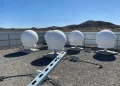
Sharp wants the terminal to be far more compact than traditional satellite dishes, and dev.ua reports the company is applying technology it previously developed for smartphones to get there. The aim is a device small and light enough to be installed on a boat or a drone. These details expand on the first reports of Sharp’s multi-network antenna earlier this week.
Sharp is positioning the product against direct satellite-to-smartphone services, which dev.ua says are already being launched or prepared in Japan by NTT Docomo, KDDI, SoftBank and Rakuten, the country’s largest mobile operators. Rakuten is working with AST SpaceMobile, the American company that competes with Starlink. dev.ua reports that direct smartphone links have bandwidth limitations and are used mainly for messaging, leaving Sharp aiming at a different niche: more stable high-speed links for machinery, drones and autonomous vehicles.
The geopolitics behind it
Sharp ties the prospects for universal terminals to growing geopolitical risks that are pushing countries to avoid depending on a single satellite communications provider, dev.ua reports. One project it names is the European IRIS² satellite system, whose development and operation involves a consortium that includes SES, the Luxembourg operator. Sharp chief executive Shigeru Kobayashi told Nikkei Asia the company can contribute to that project, partly because Sharp is not an American or Chinese company.
That last line is the pitch in miniature. The argument Sharp is making to buyers of sovereign satellite internet capacity is not that its antenna will be cheaper, but that its nationality is neutral in a market where the dominant hardware and the dominant constellation are both American.
Sharp is also building the business commercially: from 2027 it plans to offer SES services in Japan, a cooperation the companies announced in June, and it expects satellite services revenue of about 100 billion yen by 2035, a figure dev.ua carries with an approximate dollar equivalent of $630 million.
Market backdrop
dev.ua cites Global Information’s projection that the global satellite communications market could grow to $223 billion by 2033, more than double the 2025 figure. ISPreview argues that a second hardware source is a sign of the increasing maturity of high-speed satellite broadband and is relevant to larger commercial and governmental contracts.
For readers outside Japan, none of the three reports give availability, pricing or licensing detail for any specific market, and none mention Africa. The nearest comparable competitive move already covered on this site is Amazon’s South African timeline, linked above. On Sharp’s own timeline, nothing reaches customers before 2030.
Where satellite fits at Sharp
Satellite technology is one of Sharp’s new growth areas, dev.ua reports, as the company scales back the liquid crystal display business that was previously one of its core operations. Satellite terminals and AI servers sit among five areas Sharp is focusing on, and in fiscal 2030 the company expects a combined 200-300 billion yen from those new businesses – a range dev.ua reports with an approximate dollar equivalent of $1.3-1.9 billion.
What to watch next, on the evidence available: the ministry naming its two or three selected projects, any statement from SpaceX, Eutelsat OneWeb or SES about certifying third-party hardware, and whether Sharp’s SES distribution business actually starts in 2027 as planned. Until one of those lands, the universal dish remains a funded ambition described at three removes from its source.
Frequently Asked Questions
Would a Sharp dish work with an existing Starlink subscription?
None of the three reports say so, and none of them describe any agreement between Sharp and SpaceX. ISPreview’s point is that a third-party antenna maker would need the relevant satellite operator’s support, so the question is a commercial one rather than a purely technical one. Nothing in the reporting suggests existing Starlink dishes could be retrofitted, and Sharp’s own target date for first terminals is 2030.
Is Sharp guaranteed the Japanese government money?
No. dev.ua reports only that Sharp has submitted an application. The Ministry of Internal Affairs and Communications is still collecting applications and plans to select two or three projects, with state support running for a maximum of five years, according to dev.ua; ISPreview says the money supports up to three projects. None of the reports name a winner or give a decision date.
Have SpaceX, OneWeb or SES commented on the plan?
Not in any of the coverage we have seen. Telecompaper, dev.ua and ISPreview carry no response from SpaceX, from OneWeb owner Eutelsat, or from SES beyond the separate Sharp-SES distribution deal announced in June. Starlink, OneWeb and SES are named by ISPreview as networks the terminal could technically reach, not as partners that have signed up to it.
Why do the reports quote different amounts for the same government fund?
They are quoting the same Japanese budget line in different currencies. dev.ua carries a figure of up to 7 billion yen with an approximate dollar equivalent of $44 million, while ISPreview describes the commitment as over £33 million. Neither outlet publishes the exchange rate or date it used, so the gap reflects currency choice and rounding rather than a dispute about the size of the fund.
Does any of this affect buyers outside Japan?
Not yet in any documented way. None of the three reports give availability, pricing, distribution or licensing detail for a specific market outside Japan, and none mention Africa. The programme funding the work is a Japanese ministry programme, and the named early applications – defence, remote operation of construction equipment and autonomous driving – are fleet and enterprise uses rather than home broadband.
Follow Starlink News on Google. Make us a preferred source to see more of our reporting in Google search results.