Elon Musk said SpaceX has finished the design of a miniature rooftop cell tower intended to push mobile signals into buildings that satellites cannot reach, and that the company will begin launching a second-generation Direct-to-Cell satellite constellation next year. He made the comments on Wednesday at the New York Times DealBook Summit, according to reports published on 19 November by TechCrunch, Wccftech and Drive Tesla Canada.
Key facts
- Musk said the design of a small rooftop cell tower is complete, with production expected in 2027, TechCrunch reports.
- He said the SpaceX Direct-to-Cell Version 2 constellation will begin launching next year with 40 times the bandwidth of Version 1, according to Drive Tesla Canada.
- The rooftop device would use spectrum SpaceX acquired in the 800 MHz band and could be bundled with existing Starlink terminals, Drive Tesla Canada reports.
- The US Federal Communications Commission, the country’s telecoms regulator, has approved up to 15,000 V2 satellites that connect directly to smartphones, according to Wccftech.
- SpaceX struck a $17 billion deal with EchoStar, the US satellite and wireless group, in 2025 and agreed this year to acquire a low-band spectrum portfolio valued at $8 billion, TechCrunch reports.
Why it matters
Starlink’s satellite internet business runs on fixed dishes with a clear view of the sky, and its phone service has so far been limited to texting and emergency messages, with indoor coverage the weak point. Drive Tesla Canada reports that legacy providers say common building materials blocking signals from space still give them an edge over Starlink. A terrestrial device that the satellite internet operator supplies itself, paired with a much larger constellation, is the piece Musk says closes that gap.
The rooftop device
TechCrunch quotes Musk describing a plan for ubiquitous access: “We’ve got a plan that enables ubiquitous access on Earth, including via cell phone.” He said the missing piece is indoor coverage, because a thick or metal roof blocks the signal from space, so something terrestrial is needed where people actually are.
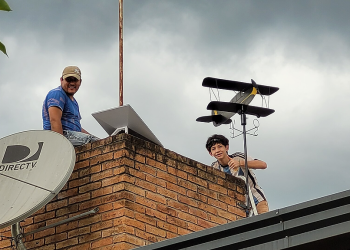
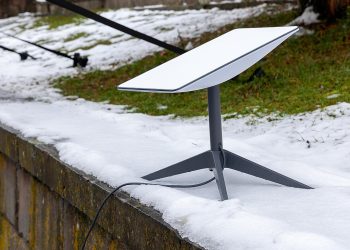
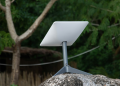
Musk described the hardware as a micro cell tower that a customer puts on the roof, like a Starlink dish, TechCrunch reports. Wccftech reports he said users will be able to mount the devices on their roofs to help signals penetrate thick walls in dense urban environments. Musk hedged the timing, saying the devices were going into production “I think” next year, both TechCrunch and Drive Tesla Canada note.
The concept is not new. TechCrunch reports that SpaceX President Gwynne Shotwell said on the company’s August earnings call that it would not use big cell towers and would instead deploy small, low-power cellular base stations. Wccftech dates the first public floating of small, low-power femtocell-type base stations on existing Starlink dishes to July. What was unclear until this week, TechCrunch says, was how much progress SpaceX had made on the hardware.
The bandwidth claims do not match
Drive Tesla Canada quotes Musk saying the V2 constellation will start launching next year and will have 40 times the bandwidth of Direct-to-Cell Version 1, which he called “some very big multiple”. That outlet points out the figure is lower than SpaceX’s own earlier claim: in October, it reports, the company said V2 satellites would offer more than 100 times the bandwidth of the current generation. Wccftech cites both numbers, referring to a claimed 20-fold improvement in link performance per satellite and up to about 100 times overall bandwidth and data density.
Two of those figures are not measuring the same thing. The 20-fold number Wccftech cites is per satellite link performance, while the roughly 100 times figure describes the constellation’s total bandwidth and data density, so a per-satellite gain multiplied across a larger fleet can produce a much bigger headline number. That does not reconcile 40 times with more than 100 times: both describe the constellation as a whole, and the lower figure is the more recent one. Neither Musk nor any of the three outlets explained the revision, and it should be read as an unexplained downward change rather than a corrected measurement.
Wccftech adds that the V2 direct-to-cell satellites are planned for Starship launches starting in 2027 and will operate in very low orbits. That is a separate line from the V3 broadband satellites now joining the network.
Spectrum, towers and the carrier problem
TechCrunch reports SpaceX’s push began with buying wireless spectrum after the FCC approved its plans in 2024 to offer a direct-to-phone version of Starlink in partnership with T-Mobile, the US mobile operator. Combining that spectrum with the mini cell towers should boost signals and end dead zones, Musk said.
The spectrum holdings
Wccftech sets out the holdings in more detail: roughly 15 MHz of unpaired nationwide AWS-3 spectrum, about 40 MHz of nationwide AWS-4, about 10 MHz of nationwide H-Block and about 14 MHz of paired spectrum in the 800 MHz band.
The carrier refusal
Wccftech reports that this is not sufficient for SpaceX to run its own mobile service in urban areas, leaving an MVNO deal — reselling capacity on another operator’s network — as its most attractive option, and that AT&T, T-Mobile and Verizon have all refused such an arrangement.
The tower leasing plan
Wccftech also reports SpaceX is trying to lease at least 80,000 cell tower sites across the US, presumably setting aside $75,000 per site, or $6 billion in total.
The threat to carriers
TechCrunch reports Musk’s hybrid cellular-satellite plan has fuelled speculation that legacy telecom companies could be in danger. Separately, AST SpaceMobile is targeting its own phone service.
Availability and price
Neither Musk nor the three outlets gave a price for the rooftop microcell or for V2 service. Drive Tesla Canada’s report that the device could be bundled with existing Starlink terminals points to it being sold as an add-on to a satellite internet subscription rather than under a tariff of its own, but SpaceX has published no figure, and the direct-to-cell texting available today is priced by its partner mobile operators rather than by SpaceX.
Availability is just as narrow. None of the three reports mentions any African market, and the spectrum, tower leasing and regulatory approvals they describe are United States arrangements. For readers in Zimbabwe and the region the binding constraint is not price but national licensing: ICASA has ordered SpaceX to halt unlicensed Starlink service in South Africa, as Starlink News has reported.
Frequently Asked Questions
How many Starlink direct-to-cell satellites are already in orbit, and what do they do?
Wccftech reports there are around 650 direct-to-cell satellites in orbit today. It describes them as Starlink V2 Mini broadband satellites with an added cellular payload, serving messaging and emergency use through partners such as T-Mobile.
What speeds is Direct-to-Cell Version 2 expected to deliver?
Wccftech says the V2 satellites are expected to reach around 150 Mbps peak in good conditions and to support full voice, data and video on unmodified phones, using larger phased-array antennas.
Where is Starlink’s direct-to-cell service already available outside the United States?
Drive Tesla Canada reports that Rogers Satellite in Canada already uses Starlink’s direct-to-cell network to provide satellite-powered texting in areas without traditional cellular coverage.
Does Musk expect this to put mobile operators out of business?
No. TechCrunch quotes Musk saying he does not think AT&T, Verizon or others go out of business because of the plan, though they may lose some revenue. He said future demand for bandwidth will be driven primarily by superintelligence and robots, which he said will need far more bandwidth than humans.