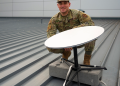
Prosecutors from Poland, Germany, Lithuania and Bulgaria are preparing to set up a joint investigation team into a series of arson attacks on Starlink satellite communications infrastructure, Polish radio station RMF24 reported on 23 November. Delegations from the four countries’ prosecution services are expected to meet in early December to begin establishing the team.
On sourcing: RMF24 broke the story in Polish at rmf24.pl, and Starlink-News was unable to locate a direct public link to that original item. Every detail below is therefore attributed to the three English-language accounts of RMF24’s report: the Kyiv Independent, republished by Yahoo News, LRT and Mezha.net, which reaches RMF24’s report via European Pravda. Where the three disagree, the disagreement is flagged.
Key facts
- On 23 September, two masked individuals allegedly set fire to a Starlink ground station in the Polish village of Wola Krobowska.
- On 9 October, an arson attack was carried out against SpaceX Starlink antennas at the Plana Teleport facility south of Sofia, Bulgaria, according to the Kyiv Independent and LRT.
- On 18 October, Lithuanian authorities foiled an attempted arson attack on Starlink equipment in Vilnius.
- Two suspects arrested in Germany on 10 October face Polish charges of sabotage and acting on behalf of a foreign intelligence service, the Kyiv Independent and LRT report — though the accounts do not agree on the men’s nationality, as set out below.
Why it matters
The Wola Krobowska site was not a consumer installation. Poland’s Deputy Prime Minister and Digital Affairs Minister, Krzysztof Gawkowski, said the day after the fire that the station, operated by the state-owned telecommunications company Exatel, served as an internet hub carrying traffic through Poland, including to Ukraine, the Kyiv Independent and LRT report.
Polish prosecutors suspect the attack was carried out on orders from Russian intelligence in an attempt to disrupt satellite internet traffic across Central and Eastern Europe, both outlets say. The infrastructure also supports Starshield, the military version of SpaceX’s Starlink system, which the two outlets describe as a critical communications tool for Ukrainian forces, supporting battlefield coordination and drone operations.
Starlink is the largest network in the commercial satellite internet market, and the gateways that link its low-earth-orbit satellites to the terrestrial internet are fixed, mappable buildings — the part of a satellite internet service that can be reached on foot with a can of petrol. That exposure matters more because of how few alternatives to Starlink’s satellite internet service exist for states that have built military and civil communications around it.
What the joint team is meant to do
The team’s remit, as described by Mezha.net citing RMF24, is to establish whether the attacks were coordinated by a single group, to identify that group’s methods and full membership, and to name the people who ordered them. LRT and the Kyiv Independent summarise the same mandate more briefly as determining whether one group was behind the incidents, who carried them out and who commissioned them.
The format itself is a standard EU instrument: a joint investigation team is a written agreement between prosecutors in two or more member states, usually set up with support from Eurojust and Europol, that lets them pool evidence directly and have investigators work on each other’s territory without filing separate mutual legal assistance requests for each step. That is the practical difference it would make here, where a single suspected campaign spans four jurisdictions and one extradition fight.
None of the three reports says the team has been formally created; all three describe the December meeting as the start of that process.
The Polish case and the arrests
Polish Prime Minister Donald Tusk said on X that the two suspects had been arrested in Germany on behalf of Polish services on 10 October, and characterised the attack as another act of hybrid warfare, according to the Kyiv Independent and LRT.
Tomasz Siemoniak, the minister who coordinates Poland’s special services, blamed Russia. The Associated Press quoted him as saying: “We have no doubt that Russian intelligence services are behind this act of sabotage.”
Where the accounts differ
The sources do not describe the suspects identically. The Kyiv Independent and LRT say Polish authorities charged two Turkish citizens living in Germany; Mezha.net, citing RMF24, refers to two German citizens of Turkish origin. The distinction is not trivial, because citizenship can shape how Germany handles an extradition request.
The Bulgarian timeline also differs. The Kyiv Independent and LRT place the attack on the Plana Teleport antennas on 9 October. Mezha.net instead dates Bulgarian authorities’ report of a possible arson attack near Sofia to 14 October — a gap that may separate the fire from its disclosure, though none of the reports says so explicitly.
What is still unanswered
Russia’s alleged interest in the constellation has surfaced in other reporting this month, including other reported Russian efforts against the constellation. In the four-country case, the question of who ordered the fires is precisely what the prosecutors say their joint team has yet to answer.
SpaceX, which operates Starlink, is not quoted in any of the three reports. Starlink-News emailed the company’s press address with questions about the attacks, the status of the affected gateways and the investigation, and had received no reply by the time of publication; SpaceX closed its media relations office years ago and seldom responds to press enquiries. Any response will be added here.
Frequently Asked Questions
How many Starlink antennas were affected in the Bulgarian attack?
Mezha.net, citing RMF24 via European Pravda, reports a possible arson attack on 11 of the 17 antennas used for communication with the Starlink satellite system at the site near Sofia. The Kyiv Independent and LRT give no antenna count.
Did the attacks disrupt Starlink service?
None of the three English-language reports describes an outage, a loss of coverage or any period of downtime for users, and none gives figures for how much traffic the affected sites carry. The damage is described in terms of the equipment targeted rather than the service delivered.
What was the target in Vilnius?
Mezha.net describes it as a Lithuanian company that stores Starlink communications equipment, rather than an operating ground station. Lithuanian Prime Minister Mindaugas Sinkevicius linked the thwarted attempt to Russia’s hybrid warfare campaign, LRT and the Kyiv Independent report.
What are the two suspects accused of, and where are they being held?
Polish authorities have charged them with acting on behalf of a foreign intelligence service and with sabotage, according to the Kyiv Independent and LRT. They remain in Germany, where they were detained on 10 October at the request of Polish services; Mezha.net, citing RMF24, says German authorities are expected to decide within two weeks whether to extradite them to Poland.