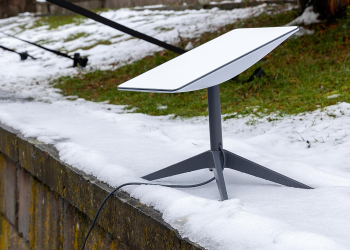
A nuclear-armed Russian satellite may reach orbit before the end of 2026, and the hardware sitting in its blast radius includes the constellation that keeps Starlink dishes online. Low-Earth orbit now holds more than 15,000 operational satellites, according to a Defense Intelligence Agency tally reproduced by Fox News Digital, and SpaceX owns the largest share of them. Starlink’s design advantage has always been redundancy: lose a handful of spacecraft and subscribers notice nothing. A warhead inverts that logic. The thousands of small satellites flying in the same shell that make satellite internet resilient against conventional attack are what make it vulnerable to a single detonation.
The satellite, designated Sputnik-S, has sat in storage in the greater Moscow area for years and could launch as early as December, in the assessment of German Space Command. That finding comes from a joint investigation published on 23 November by the German public broadcasters NDR and WDR with the Munich newspaper Süddeutsche Zeitung. The original reporting is in German; Ars Technica summarised it in English.
Key facts
- Germany’s foreign intelligence service, the BND, and the German armed forces are among the agencies named, BOL News reports.
- Systems at risk, in Ars Technica’s account: thousands of low-Earth-orbit satellites including Starlink and Starshield, Western surveillance satellites, and human spaceflight platforms such as the International Space Station.
- Stationing nuclear weapons or other weapons of mass destruction in space breaches the 1967 Outer Space Treaty.
- Two gaps remain open. Sputnik-S is described as designed to carry a warhead, not confirmed as armed, and Fox News Digital notes it is unclear whether Western intelligence has independently verified the reported launch preparations.
What degradation would mean for satellite internet users
Starlink’s value is concentrated exactly where a loss would hurt most: the places terrestrial networks never reached, as the Daily Star notes. Where the dish is the only broadband option, degradation is not a slowdown. It is coverage disappearing with nothing underneath it. Replacement satellites take years to build and launch, and with few ready alternatives to the constellation, surviving capacity would have to be rationed rather than resold. None of the published reports quantify that in subscribers, prices or country-level availability.
Rationing is not an abstraction for satellite internet customers. It is already how Starlink manages congestion today: its coverage map marks cells sold out or waitlisted where demand has outrun beam capacity, plans are sold in priority tiers, and prices are set country by country rather than globally. Nothing published connects today’s Starlink price lists or waiting lists to Sputnik-S, and SpaceX has not commented on commercial contingencies. The structural read is only this: the levers an operator pulls when capacity is scarce are ones subscribers have already met.
The Pentagon’s military intelligence arm reached the same conclusion from the military side. Its 2026 Challenges to Security in Space assessment, published in October and distributed through the agency’s own military power publications library, warned that a space-based nuclear capability could cause “rapid and sudden loss or degradation of thousands of satellites operated by countries and companies around the world,” along with the communications, navigation, scientific, meteorological, commercial and national security services riding on them. Worse, the DIA said, a detonation would leave radiation belts persisting for years, finishing off satellites that initially suffered only temporary disruption. Fox News Digital lists the civilian knock-on effects: GPS navigation, international communications, financial transactions, weather forecasting and critical infrastructure.
The contrast with Russia’s demonstrated anti-satellite weapons is the point. Those take out one or two spacecraft, an attrition rate a proliferated constellation absorbs without users noticing, Ars Technica observes. A nuclear blast is the one weapon that scales to an entire network.
Why Russia’s own losses may not deter it
Such a detonation would be indiscriminate. It would wreck Russian and Chinese satellites alongside Western ones. China operates the second-largest fleet of working satellites and would be the worst affected after the United States, Ars Technica reports. Its leadership has said nothing publicly about the Russian programme.
The asymmetry still runs Moscow’s way:
- Western exposure: the bulk of those 15,000-plus operational satellites, most of them commercial hardware, plus the satellite internet, navigation and surveillance services carried on them.
- Russian exposure: comparatively few satellites. Its recent military spending has gone on the war in Ukraine rather than on modernising its space programme, Ars Technica reports.
- One recent setback: a September launch failure cost Russia a batch of 16 satellites, according to the Daily Star — a figure no stronger outlet in this reporting has corroborated.
A weapon that destroys low-Earth orbit indiscriminately destroys least of what Russia owns. That is why Western planners treat the threat as credible rather than self-deterring.
What governments said
German Chancellor Friedrich Merz called the allegations shocking, while noting that concern about Russia’s nuclear space ambitions was not new. Speaking alongside NATO Secretary General Mark Rutte in Berlin on Monday, he said the programme showed how far Russia is apparently prepared to escalate. He did not address the timing of any launch.
Rutte’s answer was that NATO’s defence planning already covers threats in space and that the alliance holds response options not always visible to the public, Fox News Digital reported, citing Reuters. The German investigation also said military officials had briefed senior figures including Defence Minister Boris Pistorius.
Kremlin spokesman Dmitry Peskov went after the sourcing. “We haven’t seen the report. But there are so many ‘alleged’ and ‘possible’ claims in it, attributed to who knows whom, that it’s certainly hardly worth taking them seriously,” he told reporters, in remarks carried by The Moscow Times. Russia’s embassy in Berlin has described the reporting as part of a propaganda campaign. The embassy, the BND and NATO headquarters in Brussels did not immediately respond to BOL News’s requests for comment.
How far back the warnings go
- 2022 — Russia orbits a test satellite to study radiation effects on space hardware, officials disclosed later.
- February 2024 — US lawmakers briefed on the intelligence go public and the Biden administration acknowledges the programme, saying no nuclear weapon has been placed in orbit.
- 2024 — Russia, still a party to the Outer Space Treaty, vetoes a draft UN Security Council resolution reaffirming the ban on weapons of mass destruction in space, and rejects the US claims.
- October 2026 — the DIA publishes Challenges to Security in Space.
- Early November 2026 — intelligence circulating among several NATO countries puts a possible launch within 60 days, per Fox News Digital.
- 23 November 2026 — NDR, WDR and Süddeutsche Zeitung publish the German Space Command assessment.
The outlets disagree on where the story starts. Ars Technica traces the first public disclosure to early 2024 and Fox News Digital dates the administration’s acknowledgement to February 2024 — the same episode from two ends. The Daily Star’s claim that Washington first warned of Russia’s plans in February 2023 matches neither, and most likely refers to earlier closed briefings to allies rather than any public statement.
Russia’s other activity in orbit
A senior US Space Force general says Russia is now operationalising a kinetic anti-satellite weapon — one satellite firing projectiles at another — which it has already tested, according to Ars Technica. It follows a separate report on a Russian weapon aimed at the constellation. Russian military satellites have also shadowed sophisticated US Keyhole-class spy satellites. Last month one Russian spacecraft closed to within “tens of meters” of a commercial radar satellite owned by the Finnish company ICEYE, which supplies imagery to Ukraine’s military, before backing away, a US official told Ars Technica.
The Ukraine dimension
Ukraine’s military leans heavily on satellite communications, Starlink included, and has been working to reduce that dependence, Fox News Digital reports. The Daily Star says that after SpaceX limited performance, Ukrainian officials opted for their own “flying modems” rather than rely on Elon Musk’s company; that account rests on a single tabloid report with no corroboration from a stronger outlet. Both Starlink and Starshield, SpaceX’s military network, appear on Ars Technica’s list of systems a detonation would threaten.
The timing carries its own signal. The intelligence reports surfaced four days after President Donald Trump met Vladimir Putin and Xi Jinping at a summit in Shenzhen, China, where nuclear arms control was a central topic and the three leaders issued a joint declaration that nuclear war should never be fought — with no binding commitments attached, Fox News Digital notes.
Frequently Asked Questions
Has a nuclear weapon ever been detonated in space before?
Yes, once, and the result is the closest thing to a precedent for this scenario. In July 1962 the United States detonated a 1.4-megaton device roughly 400 km above the Pacific in the Starfish Prime test. The blast seeded artificial radiation belts that crippled or shortened the lives of several early satellites, including the Telstar 1 communications satellite. Orbit then held a few dozen spacecraft; it now holds tens of thousands, almost all of them unhardened commercial hardware.
Would Starlink users lose service the moment such a weapon went off?
Not necessarily all at once. A dish could keep working and then fail weeks or months later, as individual satellites die off and the replacement rate falls behind the losses. That attrition curve is the part nobody has modelled: none of the published reporting projects it for any specific country or market, so there is no basis for telling a subscriber in Lusaka or Lagos how long their service would hold.
Would a detonation damage dishes and ground equipment too, or only satellites?
The published reporting on Sputnik-S concentrates on orbital effects, but the 1962 test showed the ground is not immune: the pulse tripped streetlights and knocked out a telephone microwave link in Hawaii, roughly 1,400 km from the detonation point. The Defense Intelligence Agency’s warning about knock-on damage to critical infrastructure covers that category of effect. No source has published a damage estimate for consumer satellite internet terminals specifically.
What would actually happen legally if Russia launched it?
Less than the treaty language suggests. The 1967 Outer Space Treaty bans stationing weapons of mass destruction in orbit but contains no verification regime and no enforcement machinery — no inspections, no penalties, no court with jurisdiction. Enforcement would fall to political and economic responses by other signatories, which is why NATO officials have been talking about defence planning rather than legal remedies.