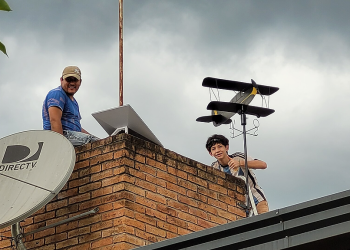
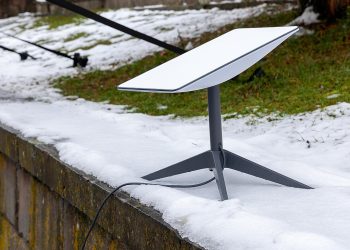
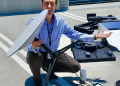
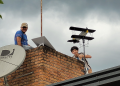
Elon Musk says SpaceX will offer Starlink Mobile subscribers a compact microcell device that mounts on a rooftop and helps cellular signals get through thick walls in densely built cities. He disclosed the plan on Wednesday during appearances at The New York Times’ DealBook event and the TomorrowX Summit, according to reports published on 19 November by finance.biggo and Wccftech.
Key facts
- The units are meant to address the signal penetration problem in urban areas, where masonry and concrete can block indoor reception, finance.biggo reports.
- The two outlets differ on the commercial model: finance.biggo says SpaceX plans to sell the device to subscribers, while Wccftech says SpaceX will provide it. Neither gives a price.
- Wccftech says the idea extends a proposal SpaceX floated in July for small, low-power femtocell-type base stations attached to existing Starlink dishes as a low-cost way to spread its mobile service.
- SpaceX is seeking to lease at least 80,000 cell tower sites across the United States, a commitment both outlets put at roughly $6 billion at an estimated $75,000 per site.
- The US Federal Communications Commission has approved SpaceX to launch as many as 15,000 second-generation satellites able to connect directly to ordinary smartphones.
Why it matters
Finance.biggo writes that the rooftop microcell proposal signals SpaceX intends to compete for urban subscribers rather than confine Starlink Mobile to rural and emergency use. The same report notes that building a terrestrial network dense enough to serve cities would require substantial capital spending on tower leases and ground equipment.
Both reports deal with United States spectrum, US tower sites and FCC licensing. Neither addresses when or whether the device, or Starlink Mobile itself, would reach other markets.
The spectrum squeeze behind the device
Both outlets list the same terrestrial holdings: roughly 15 MHz of unpaired nationwide AWS-3 airwaves, about 40 MHz of AWS-4, around 10 MHz in the H-Block and around 14 MHz of paired spectrum in the 800 MHz band.
That is not enough to run a full mobile service in urban markets on its own, both reports say, which is why an MVNO arrangement — reselling capacity on another operator’s network — with AT&T, T-Mobile or Verizon has remained the most attractive route. All three have declined, according to both outlets, leaving SpaceX to lean on its space-based 2 GHz mid-band spectrum as the backbone of a US cellular network while the 800 MHz licences, which finance.biggo says SpaceX agreed in October to buy, carry signals into buildings. Verizon’s chief executive has separately put a figure on what it would cost to copy a national network.
A bigger direct-to-cell constellation next year
Musk also said SpaceX will begin launching a direct-to-cell Version 2 constellation from next year. “I think it will have 40 times the bandwidth of the current direct-to-cell Version One,” he said, as quoted by Wccftech, adding: “That’s where the 800 megahertz band that we bought comes into play, with a network of very small ground stations.”
The current fleet of roughly 650 direct-to-cell satellites is essentially SpaceX’s V2 Mini broadband craft fitted with a cellular payload, serving messaging and emergency traffic through partners such as T-Mobile, both reports say. The V2 spacecraft carry larger phased-array antennas and are designed for Starship launches beginning in 2027, with peak speeds of around 150 Mbps under good conditions and support for voice, data and video on unmodified phones. Wccftech adds that SpaceX claims about a 20-fold improvement in link performance per satellite and up to roughly 100 times the overall bandwidth or data density.
Musk used the same appearances to argue that SpaceX’s plan to put computing in orbit is the easier engineering problem. “I’m not sure why people think that making an AI satellite would be hard, given that SpaceX already has over 11,000 satellites in orbit, which is, I think, twice as much as the rest of the world combined,” he said, in remarks carried by both outlets.
Carriers moving in the other direction
Finance.biggo reports that the microcell plan lands as established carriers close their own satellite coverage gaps. T-Mobile has offered its T-Satellite direct-to-cell service, built with SpaceX, since July 2025, while Verizon, AT&T and T-Mobile launched a joint venture in October aimed at expanding satellite connectivity and eliminating coverage gaps.
Gwynne Shotwell, SpaceX’s chief operating officer, said in August that she expects the coming Starlink Mobile network to win “quite a few” customers from the three national carriers, finance.biggo reports. The carriers, that report says, are betting that the constellation of AST SpaceMobile — the satellite partner of Verizon and AT&T — can narrow the lead T-Mobile holds through its SpaceX partnership.
Wccftech’s assessment of where the plan leaves SpaceX is blunter: “It seems the jigsaw puzzle pieces are finally falling into place for SpaceX.”
Frequently Asked Questions
How much will the rooftop microcell cost, and when can subscribers get one?
Neither report gives a price or a launch date for the device. Finance.biggo describes it as something SpaceX plans to sell to Starlink Mobile subscribers, while Wccftech frames it as a device SpaceX will provide to those users; both say only that it mounts on a roof and helps signals get through thick walls.
What is AST SpaceMobile and where does its satellite service stand?
AST SpaceMobile is the satellite partner of Verizon and AT&T, and finance.biggo reports it intends to offer intermittent nationwide coverage in key markets including the US by the end of 2026. It had expected about 45 BlueBird satellites in orbit by then but has moved that target to mid-2027, and says 45 to 60 spacecraft would give continuous coverage, with more than 100 planned for 2027 to 2028. Beta trials with partner carriers’ customers are expected in early 2027, with about 25 satellites considered sufficient, president Scott Wisniewski said on a 9 November earnings call.
How big is the direct-to-device market expected to get?
Finance.biggo cites a March projection from the research firm Omdia that global satellite direct-to-device services will reach 411 million monthly active users and generate $11.99 billion in revenue by 2030. Omdia expects that kind of connectivity to become a standard add-on to mobile plans.
What did Musk say about the StarMind satellite?
Musk called StarMind, the name he gave SpaceX’s overall compute system in space, simpler to build than the Starlink V3 communications satellite, which he described as an incredibly complex orbital radio station. According to Wccftech he said the AI satellite is essentially a very large solar array plus a radiator, with roughly five times as much panel area as radiator area, and a central computer about a quarter the physical size of a Vera Rubin NVL rack while matching the capability of a Vera Rubin NVL72.