Elon Musk said on Sunday, 22 November that he hopes to put built-in Starlink in more Teslas by late 2027, and he tied the plan directly to a version of Full Self-Driving that needs no supervision. The reply on X went to David Marcus, the former PayPal president, who had asked whether the satellite connection would reach all of Tesla’s models rather than just the Cybercab, according to Tesla North.
That makes the satellite rollout dependent on a driving feature Tesla has not yet released to private owners. Here is what Tesla and its executives have actually said about both.
Key facts
- Musk’s words were “hopefully available towards the end of next year”; Tesla North stresses this is the window he is hoping for, not a launch date Tesla has announced.
- His stated reason: unsupervised FSD passengers need high bandwidth everywhere for work and entertainment.
- Tesla’s current connectivity plans run on cellular data and Wi-Fi for navigation and streaming, per Tesla North.
- Ashok Elluswamy, Tesla’s director of Autopilot software, told shareholders on 21 October that the first customer-owned cars to drive without a human supervisor could be switched on “somewhere around Q2 next year”, The Auto Wire reported on Yahoo Finance.
- Tesla ran unsupervised Robotaxi service in eight cities as of the San Antonio launch, according to Drive Tesla Canada.
Why it matters
For anyone following where satellite internet shows up next, this is the clearest statement yet that SpaceX’s consumer network is being designed into a car platform rather than sold as an add-on dish. But the trigger Musk named is software that Tesla’s own support page contradicts: The Auto Wire quotes that page as saying every Tesla requires active driver supervision and is not autonomous.
The money already collected points the same way. Tesla’s quarterly report to the SEC put deferred revenue tied to “internet connectivity”, FSD (Supervised) features and their maintenance, free Supercharging and over-the-air updates at $4.08bn on 30 September 2026, up from $3.87bn on 31 December 2025, The Auto Wire reported. The outlet notes the line bundles several services, so the FSD share is not broken out, and that deferred revenue is cash taken for services Tesla still owes.
How far unsupervised driving has actually got
Elluswamy said the software for Cybercabs and the Model Y “is the same”, and that Tesla expects to release it to customers as part of its V15 release, The Auto Wire reported. The one added requirement he gave was making sure customer Model Ys can be part of the geo-fences and fleet management Tesla runs, with the first unsupervised owner cars arriving as members of the Robotaxi fleet in Austin, Texas.
The target has moved. On the 23 July 2025 earnings call Musk said unsupervised FSD would be “available for incentivized personal use by the end of this year in certain geographies”, and added he was confident it would reach end users in a number of US cities by then. The Auto Wire calculates that the date Tesla now gives lands 15 to 18 months after that promise, and notes Elluswamy’s wording was softer: “we suspect”, “some of the first customer vehicles”.
Tesla’s Q3 2026 update says Robotaxi riders have logged “nearly two million cumulative unsupervised miles”, and that cumulative unsupervised miles grew eightfold from the prior quarter, according to the same report. Tesla has also dropped the Full Self-Driving name in Europe, where the product is called Tesla Assisted Driving, and a federal appeals court vacated class certification in a California FSD buyers’ case on 16 October, sending it back to the district court without ruling on the merits.
The cities already running it
Drive Tesla Canada reported that Tesla launched Robotaxi service in San Antonio at 5am local time on a Monday, a week after adding Fort Worth, making eight cities with unsupervised Robotaxi service: Austin, Houston, Fort Worth, Dallas, Miami, Orlando, Tampa and San Antonio. By its estimates San Antonio covered about 275 square miles (712 square kilometres), the largest area Tesla had opened at launch, while Houston ran to about 254 square miles and Fort Worth 143 square miles. Austin’s area grew 63% the same day, adding 171 square miles to reach 443 square miles (1,147 square kilometres).
What is in the cars today
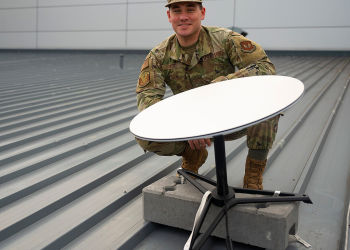
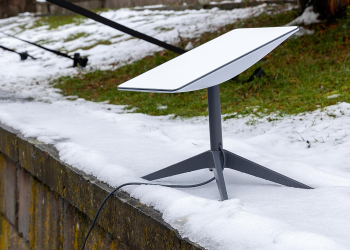
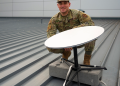
The two-seat Cybercab is the one model where the hardware is visible: Starlink hardware is already in every Cybercab, and Tesla North reports that newer vehicles photographed at Giga Texas carried a darker cover on the rear hatch, in the same area as the antenna sitting on the Cybercab trunk lid. Tesla’s Cybercab subscription terms say vehicle connectivity may include satellite service.
Nothing comparable has been promised for the existing line-up. Tesla North says Musk did not say whether current owners could add the hardware, did not name any model, and gave no price. CarBuzz’s account of the latest North American Model 3 changes lists a 16-inch centre screen, 528 horsepower for the Performance, a 316-mile range estimate and a 3.8-second 0-60mph time for the Premium AWD, with no satellite equipment mentioned.
Frequently Asked Questions
Will built-in Starlink come to Teslas sold in China?
No. Tesla North reports that Musk singled out China as an exception in a later reply on X, and that automotive outlets CarSauce and TeslaNorth said the reason is that Starlink is illegal there. Musk did not name any other excluded market.
Does the FSD v15 update let a Tesla drive without a driver watching?
No. Tesla North says the FSD v15 update now reaching owners still requires an attentive driver. The Auto Wire quotes Tesla’s own support page as saying: “All Tesla vehicles require active driver supervision and are not autonomous.”
Does Texas law require an owner’s car to join Tesla’s fleet to drive unsupervised?
No. The Auto Wire reports that the Texas Department of Motor Vehicles says personal-use vehicles do not need the automated vehicle authorisation that commercial driverless operators do. The fleet condition Elluswamy described comes from Tesla’s own geo-fences and fleet management, and once a car is in the fleet it falls under the commercial rules, with Tesla holding the authorisation.
How many people are paying Tesla for FSD?
Tesla’s Q3 2026 update filed with the SEC lists 1.74 million active FSD subscriptions, up from 1.04 million in the third quarter of 2025, according to The Auto Wire. Tesla says the figure covers upfront payments and monthly subscriptions and excludes free trials.