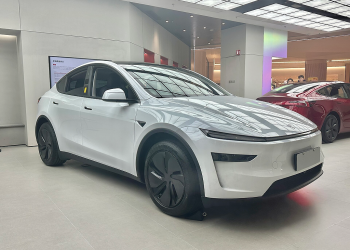
Tesla’s Model Y crossover is in line to get a factory-installed Starlink satellite antenna, the Ukrainian technology site hi-Tech.ua reported on 25 November, with the connection intended to keep Tesla’s robotaxi fleet online rather than to entertain passengers. The move follows exchanges on X over the weekend of 22–23 November in which Elon Musk said he hoped a built-in Starlink option would reach all Tesla models “towards the end of next year,” as reported by Yahoo Finance. Those replies were posted by Musk from his own X account, in threads started by Lightspark chief executive David Marcus and Tesla investor Sawyer Merritt; Tesla has published nothing on the plan.
Key facts
- hi-Tech.ua says that from 2027 all new Tesla electric vehicles are planned to leave the factory with built-in Starlink hardware, including the Model 3 and Model Y.
- The Cybercab, Tesla’s two-seat driverless vehicle, was the first model to receive a factory-installed satellite antenna, according to hi-Tech.ua.
- Musk said the option would not be offered in China, Yahoo Finance reports.
- Tesla’s existing Model Y-based robotaxi fleet has no factory-installed Starlink modules, per hi-Tech.ua.
Why it matters
Both reports tie the hardware to driverless operation rather than to in-car streaming. hi-Tech.ua says uninterrupted connectivity is critical for fleet management and navigation, and for the effective operation of unsupervised FSD (Full Self-Driving) software, which it describes as the backbone of the robotaxi service.
Musk framed the benefit for passengers too. “This will be important for unsupervised FSD, so passengers have high bandwidth everywhere for work and entertainment,” he wrote, as quoted by Yahoo Finance.
Any car option would sit on the same satellite internet service Starlink already markets for homes, vehicles, boats and aircraft, alongside the direct-to-cell product aimed at ordinary phones — so where the cars could actually use it would follow Starlink’s own country-by-country availability.
What goes in the car is not settled
Roof module or hidden antenna
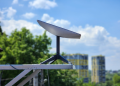
hi-Tech.ua says the form factor has not been finalised: either a roof module like the Cybercab’s or a more discreet unit built around modern satellite modems. The outlet also sets out, as its own unconfirmed reading rather than company policy, a path in which Model Y robotaxis run HW4 or HW5 hardware with active Starlink integration and later versions drop the pedals and steering wheel for the Cybercab’s architecture, making constant satellite connectivity a safety requirement.
Samsung and Qualcomm chipset work
SpaceX is working with Samsung and Qualcomm on compact chipsets that could replace external antennas in future Teslas, hi-Tech.ua says. Qualcomm is already supplying hardware elsewhere in the Starlink programme.
Where the two reports differ
The sources do not describe the same timetable. hi-Tech.ua presents factory-fitted Starlink as company plans starting in 2027 across all new electric vehicles. Yahoo Finance reports a softer commitment: a hoped-for option by the end of 2027, in reply to Marcus asking for built-in Starlink across the range, beyond the Cybercab. hi-Tech.ua does not mention the China exclusion.
Who has money in this
Tesla would buy the connection from SpaceX, which operates Starlink, Yahoo Finance reports — and because Tesla would be buying from a company Musk also runs, the outlet argues, the undisclosed per-car charge decides which set of shareholders keeps the margin. The same report notes that AT&T, the US telecoms group, signed an exclusive deal in 2014 to supply the cellular connection in Tesla’s North American cars: the link a satellite antenna would sit alongside, or displace.
On price, Yahoo Finance says Tesla already charges about $10 a month in the United States for Premium Connectivity, which runs over cellular, and that nothing Musk has said reveals what a satellite tier would cost or what SpaceX would charge Tesla per car. Starlink’s own consumer pages sell in-motion service to drivers under its Roam plans and list no Tesla option. SpaceX’s wider plans remain in motion, including clearance for up to a million Starmind satellites.
Background: the Cybercab start in Dallas
The Cybercab launched in Dallas on 19 November, Yahoo Finance reports, and every Cybercab already ships with a Starlink antenna, mounted on the trunk lid of the Dallas cars. The outlet describes the case for the hardware in terms of what a rider in a car with no steering wheel does with the trip: a sales call on the way to the airport, a film on a long highway drive, a child’s tablet that keeps streaming after the last cell tower. That, it says, is worth more to Tesla than the subscription money.
Frequently Asked Questions
Will built-in Starlink be offered on Teslas sold in China?
No. Asked by Tesla investor Sawyer Merritt whether every model could get Starlink by the end of 2027, Elon Musk replied: “Except in China, as Starlink is illegal there,” according to Yahoo Finance. The same report notes China accounted for 22.1% of Tesla’s 2025 revenue, but argues the exclusion may matter less for robotaxis because such a service starts in big cities where cellular coverage is strongest.
Can riders in the Dallas Cybercabs use the Starlink connection today?
Apparently not yet. Yahoo Finance quotes Merritt as saying the Cybercabs already have Starlink “although it doesn’t seem like riders can connect to it yet.” Neither source says when passenger access will be switched on.
Has Musk met his robotaxi timelines before?
Yahoo Finance points out that his timelines slip: in January he expected driverless rides in “dozens of major cities” by the end of 2026, and Tesla said in October that robotaxis were running fully driverless in six. The outlet also stresses that Musk said only “hopefully” about the end-of-2027 target for built-in Starlink.