Tesla launched Cybercab ride-hailing service in Dallas on Thursday, according to shattered.io, and the cars reaching the city carry a hardware revision that basenor identifies as the Cybercab V1.5, built around a factory-fitted Starlink terminal. Both accounts rest on the same source material: drone photographs taken by Joe Tegtmeyer over Tesla’s Gigafactory in Texas, showing rows of finished Cybercabs with the new enclosure staged beside transport trailers. Neither Tesla nor SpaceX has confirmed the V1.5 designation or published a hardware description, so the specifics below are reported, not verified.
Key facts
- basenor says Dallas is the eighth metro in Tesla’s Robotaxi network, after Austin, Houston, Fort Worth, San Antonio, Miami, Orlando and Tampa, and that initial Robotaxi rides there began on October 29.
- Tesla registered 200 new Cybercabs in Texas on November 17 alone, taking the state total to 773 units, according to data tracked by Cybercab Collective and registration trackers cited by basenor.
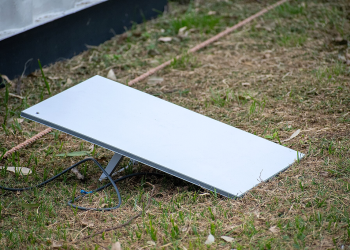
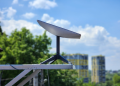
- The Starlink V5 terminal is 35% smaller and 62% lighter than the V4, weighs roughly 1.1 kg and draws 35–50 watts, basenor reports, citing SpaceX specifications.
- Riders cannot yet use the connection: basenor cites Sawyer Merritt saying riders cannot connect to the hardware, and shattered.io reports a passenger on an early September ride said no Starlink connection was available.
Why it matters
basenor calls it the first time Starlink hardware has appeared as a factory-fit feature on a Tesla vehicle rather than an aftermarket install. It also marks the first market outside Austin for the purpose-built car, shattered.io reports, where the service began in September.
What changed in V1.5
basenor lists an integrated Starlink antenna, slightly improved seats, minor suspension component upgrades it describes as unlikely to be perceptible to riders, and a new trunk-lid camera for cabin and exterior monitoring.
Where the antenna actually sits is an open contradiction between the two reports, not a difference of wording. shattered.io says the drone images show a square panel toward the rear of the roof, in the spot Tesla’s own hardware diagram labelled “Starlink Integration”, and that it looks darker than on cars photographed leaving the line in September. basenor describes an enclosure flush-mounted into the rear bodywork at the hatch. Both are reading the same aerial photographs; only one placement can be right, and neither company has settled it. shattered.io also notes earlier sightings of Starlink hardware on every Cybercab.
What the satellite internet link is for
Ashok Elluswamy, Tesla’s vice president of AI software, said on the day of the July announcement that the link is intended mainly for navigation, customer support and fleet management, and is not a requirement for the vehicle to operate safely, shattered.io reports. Musk framed it on the second-quarter earnings call as coverage: robotaxis need connectivity wherever they go, and cellular signal is unreliable in some areas.
basenor is blunter: Starlink is not part of Tesla’s autonomous driving stack, which runs entirely on onboard compute, and the dish is a passenger-experience and fleet-ops layer. The same report puts V5 download speeds above 375 Mbps in field tests, enough to stream 4K video, join calls, game or work during a ride; Musk said in September that riders would be able to watch 4K live video in the cabin, according to shattered.io. Readers can compare Starlink V5 against the older V4 dish for the trade-offs in that generation.
What it costs
- A personal Cybercab starts at $29,990 plus a mandatory $299-a-month Autonomy Subscription, according to basenor.
- By the 45th month that fee makes the Cybercab dearer than a base Model 3 on Tesla’s supervised full-self-driving subscription, and by year five it exceeds a larger Model Y on the same plan, shattered.io reports.
- Musk conceded the gap on X, writing that the monthly charge was “too high” and should be closer to the roughly $115 a month Tesla charges for FSD and connectivity on other models. No cut has been announced.
- None of that is Starlink pricing. SpaceX sells consumer satellite internet separately — its US pricing page lists Residential service at $120 a month with a $349 Standard kit — and neither Tesla nor SpaceX has said what the fleet terminal costs, who pays for its data, or whether a Cybercab owner is billed for the link at all.
What comes next
- basenor says pilot production of the Cybercab started at Giga Texas in February 2026, and that the Dallas cars were built alongside Model Y, Model Y L and Cybertruck.
- All Tesla vehicles are expected to gain Starlink connectivity before the end of 2027, excluding China, where Musk confirmed the service is illegal, basenor reports, citing The Tesla Newswire — the timeline behind reports that Musk is weighing built-in Starlink for the rest of the Tesla line-up.
- Musk said on X that the connection will be “important for unsupervised FSD, so passengers have high bandwidth everywhere for work and entertainment”, according to basenor. He has not said when riders will be able to use it.
Frequently Asked Questions
Can people who buy a Cybercab put it on Tesla’s ride-hailing network and earn money?
No. According to basenor, personally owned Cybercabs are geofenced to Tesla’s eight Robotaxi service areas and cannot be used to run rides on Tesla’s network, so owners cannot earn revenue by dispatching their own car into the ride-hailing pool.
When do the first Cybercab deliveries to private buyers start?
Both basenor and shattered.io put the first deliveries in Austin in December 2026. basenor adds that orders are taken by invitation and require a non-refundable $1,000 deposit on Tesla’s ordering page.
What does the $299 monthly Autonomy Subscription cover?
According to shattered.io, the subscription bundles roadside assistance and maintenance items including tyre, windshield and wiper replacement. Neither report says the Starlink terminal’s data or service is itemised within that fee.
What stands in the way of selling cars with no steering wheel across the United States?
shattered.io reports that US federal motor vehicle safety standards assume a steering wheel and pedals, so volume service without them requires rulemaking or exemptions. The same report says the Cybercab has faced a National Highway Traffic Safety Administration audit inquiry since September, and that Musk has said the vehicle will be offered nationwide once approvals come through.